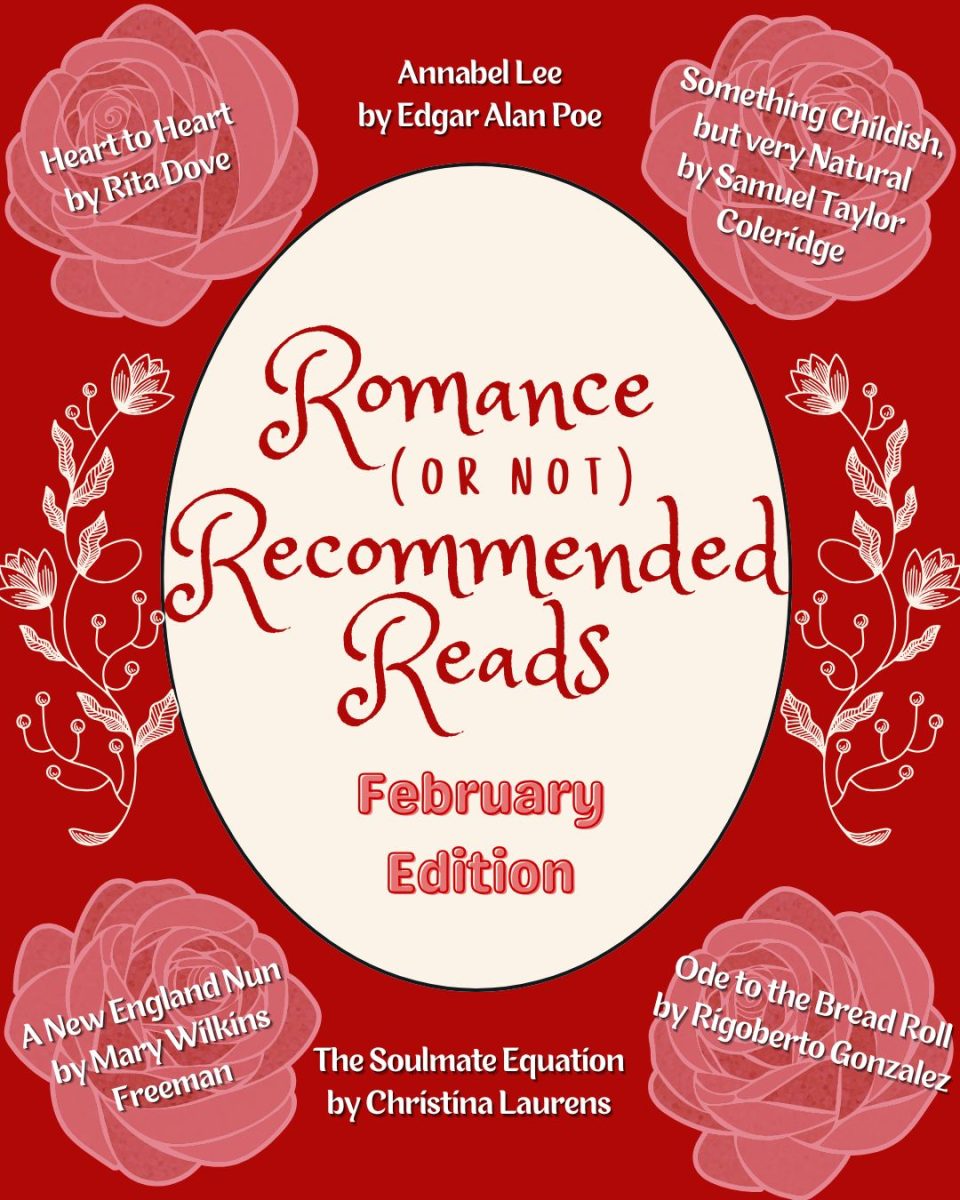





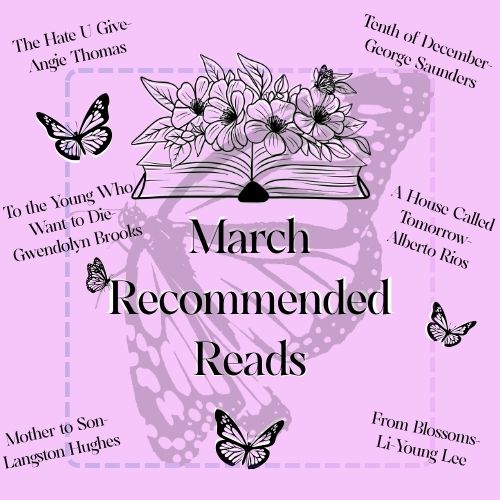
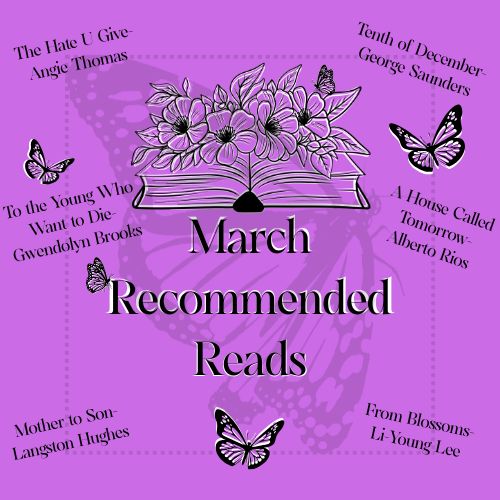
Correction: The image previously listed the incorrect author for two listed works. “To the Young Who Want to Die” was written by Gwendolyn Brooks and “From Blossoms” was written by Li-Young Lee, not George Saunders.
Selections:
- Angie Thomas The Hate U Give (novel)
- Langston Hughes “Mother to Son” (poem)
- Gwendolyn Brooks’ “To the Young Who Want to Die” (poem)
- Li-Young Lee’s “From Blossoms” (poem)
- Alberto Rios’ “A House Called Tomorrow” (poem)
- George Saunders “Tenth of December” (short story)
Love reading? Have a passion for words? Want to try reading this month? Want to feel a little more hope? I have an amazing list that I recommend. They’re quite short and powerful, as I’ll soon describe.
I hope that, this month, you’ll be inclined to read over these selections of short stories and poems that I would definitely recommend. We all need that little motivation in our lives and I know that these texts can grant some of it. When the world can seem a little uncertain, at any point in life, these beautiful works can sometimes liberate and release the weight from your shoulders, or simply at ease from taking that midterm exam. Especially when you need them most.
The Hate U Give by Angie Thomas
The Hate U Give is a popular novel by Angie Thomas that was inspired by the Black Lives Movement. The story revolves around Starr Carter, a 16-year-old who witnesses the unjust fatal shooting of her friend, Khalil, at the hands of a police officer. After the incident, Starr balances between who she is and what she must become on a personal level. She must also make the choice of defending the person that Khalil was against the assumptions that are made of him despite the intimidation of the police and the drug lord of the neighborhood.
Not only does the storyline seem to accurately reflect real-world situations, but the first-person point-of-view writing is superb. Character development is clear and written skillfully, with even some secondary characters showing signs of character development. The novel masterfully reflects the conflicting emotions in Starr as she navigates through the challenges of being a witness to a fatal shooting, attends a “fancy suburban prep school” while living in a poor neighborhood, and managing emotions like anger, self-doubt, grief, among others.
It’s a story about inner conflict, discrimination, and the unending unfairness in the world. During times where it seems like the world is trying to push you down, this story reminds you of what to live for and what to fight for.
“Mother to Son” by Langston Hughes
The first poem that I’ll be listing! But certainly not the last!
Langston Hughes, legendary writer during the Harlem Renaissance, master of combining words into fluid dialogue and motivation –which is exactly what he did in “Mother to Son”. As the name suggests, it’s a poem completely of dialogue, a mother speaking to her son about her troubles before revealing to the audience the real message of the poem.
Her tribulations are the foundation of her motivational statements, giving the son (or Hughes’ audience) the message that is clear enough to understand. All the while making it even clearer by using a metaphor to describe these obstacles. I like this poem because you can almost hear the mother’s voice trying to get through to the son. Of course, this is before she fully delivers the message that I don’t doubt everyone needs to hear once in a while. I just love how this is a beautiful poem of 20 lines that emphasizes the hopeful lesson to the audience by masking it as a message from a mother to her son. Something I definitely believe you have to read to believe to see how the powerful lesson is delivered.
“To the Young Who Want to Die” by Gwendolyn Brooks
Triggering content: as the name suggests, this poem refers to suicide.
A short and amazingly underrated poem of 17 lines by Gwendolyn Brooks –the first African American woman to win a Pulitzer Prize. Free-verse in its style and motivational in its theme, the poem is something that so many people would benefit from hearing in their time of loss, despair, or hopelessness.
It’s the type of poem you really have to read to find the power and beauty in it. You can really hear the emotion in each word, hear the passion and the pleading in the poem that makes it such a marvelous read. It’s complex enough to make the poem interesting, but short enough to not take too much time to read, but long enough to get the message clear and straightforward. From the start, you can clearly see the message. It’s not hidden or implied or obscure. It’s honest, relieving, and true. It’s especially something many people should hear more often.
“From Blossoms” by Li-Young Lee
A simple moment, normal behavior, complex emotions. Eating a peach can have so much symbolism and deeper meanings, which is exactly what Li-Young Lee demonstrates in this poem. Eating a peach might not seem like much at first thought (I definitely didn’t think of it that way!). However, the way Lee frames this poem shows how even the simplicity of things can have deeper meanings and emotions.
The moments that people live through, the smallest and calmest, are significant in interesting ways as the poem advises us. In particular, it seems to have the ability to make someone see how much they should enjoy each and every second, every moment existing in between the obstacles, the worries, or the tragedies. Deep emotions with just a brief period in life. There’s just something so deep and powerful in the poem’s use of imagery and metaphor.
“A House Called Tomorrow” by Alberto Rios
The final poem. But it certainly doesn’t make it the best nor the worst read. This free-verse poem summons hope, piques interest, and warms hearts. The speaker in Rios’ poem tackles the idea of a “good” human being amidst generations of people. Admittedly, this is a little longer than the other poems on this list, but the length doesn’t matter when you take into account the uplifting messages and the inspiring ideas.
Rios’ poem is beautifully written, with fascinating takes on some phases of life as well as the generations that have come before us –and this is just a bit of what the poem offers! It gives the necessary hope for the next day, and the day that follows, and the day that comes next, even if there’s thunder. Actually, it doesn’t just give you hope for the world, but hope in yourself, hope that goodness does exist.
“Tenth Of December” by George Saunders
Triggering content: references to suicide and bullying
“Tenth of December” is a short story I recommend, but not to be underestimated by the rest of the shorter works. It’s a story of an unlikely encounter between two very different characters: a cancer patient in his 50s and a bullied boy who relies on imagination to keep him company. One who is wanting to not become “THAT” (you’ll have to read and find out what it is!), and the other just fighting the Netherworlders (again, read and find out!). The two meet in such a strange and unexpected way. Their interactions together, or their behaviors separately, can bring at the very least, a smile upon one’s face.
I absolutely adore this short story because there are so many things to think about: the silly perspective with Robin, the adult-like mindset in the perspective of Don Eber, whether either successfully goes through with their plans, whether there really exists happiness in the middle of trouble. You’ll laugh or smile in the beginning just as much as you’ll feel warmhearted by the end.
Enough of me speaking of these incredible works! Read them! I’m sure that you’ll enjoy at least one of these works (if not a few or all of them). Their works inspire hope in people, especially during their time of need, or during times of uncertainty. I sincerely hope that you are able to find these works as soulful, inspiring, and influential as I did. Get ready for the end of the month to find a recap (with spoilers) of all my recommended reads!