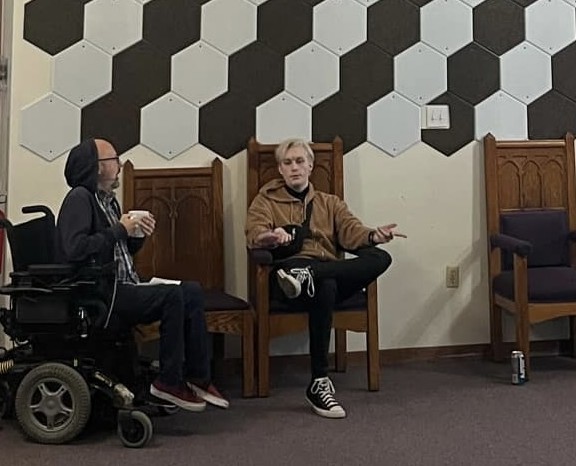








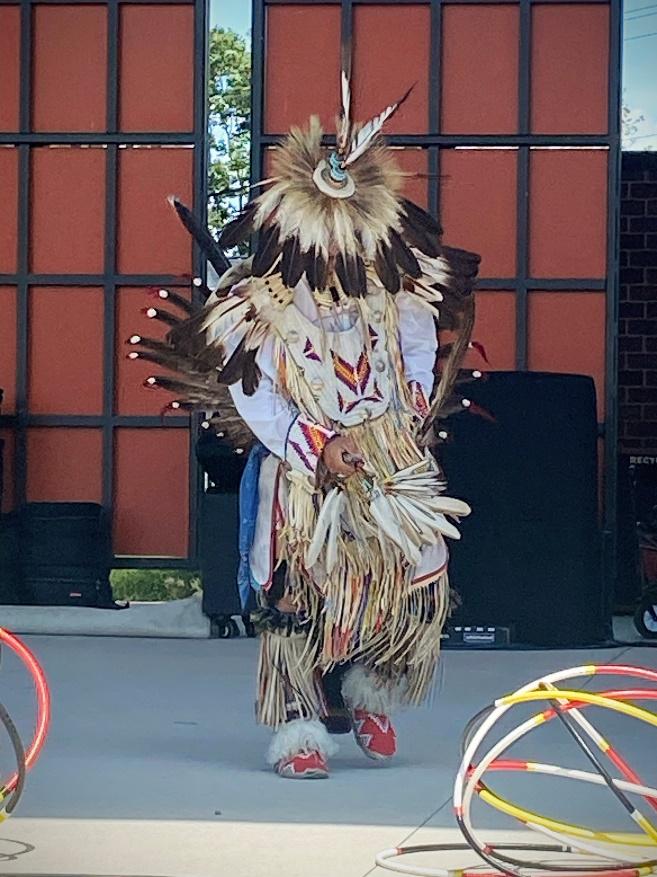
Dennis Rogers, also known as “Spirit Dancer,” is a retired history teacher who performs traditional Navajo dances and sings songs in the Navajo language, Diné Bizaad, across the country in schools and other events. Rogers is part of the Navajo tribe from a town on the reservation in Chambers, AZ. He seeks to preserve the Navajo language and inspire others to speak and keep their own cultures and languages alive, stating“the best part of our culture probably number one will be the language”.
Culture forms a vital part of who we are as people, as Rogers states “I guess you just (…) I don’t want to say take it for granted, but you just accept these things as a norm.” Rogers reminisces on various ceremonies and customs from his childhood like the Canalda, a ceremony that represents the transition from a girl to a woman. The land and sites of the reservations –the structures of the building– all these things Rogers feels are important to him and his culture.
Rogers mentioned the Navajo language and the current generation’s struggle with language. Most do understand the language from growing up, but many can’t speak it. Those who know the language may not speak it due to a combination of being shy or nervous about messing up and being ridiculed.
According to the Navajo Times, in the span of just 10 years the percentage of Navajos who speak the language has dropped by around 25 percent. The organization also notes the concern that by 2030, only 10 percent of those in the Navajo tribes will be able to speak the language with some fluency.
This is a truth many people in this country face in certain communities such as the Latinx/Hispanic community. There is an insult for people who grew up in America and speak a kind of broken Spanish: they call them “no sabo” kids. It’s things like this that can cause people to engage in their culture less, as Rogers worries. “I say, don’t be too hard on yourself if you don’t speak your language fluent(ly), because we weren’t brought up in that environment where it was conducive to do that.” Rogers sympathizes with this plight that many Latinx/Hispanics face.
Rogers speaks on how this issue affects everyone. His native tongue isn’t as easy as it once was for him, “I forget some of the words and how they are put together.”
Earlier he had told everyone in the audience that “there is no shame in mispronouncing words as long as you’re making an effort it shows that you care.” When asked why he performs, he answers that it’s about hope. He hopes that “maybe 20, 30 years down the line once I’ve passed, that hopefully I’ve inspired someone to pick up their culture and perform, sharing it with others and keeping it alive.”
In addition, some of what must also be recognized is the struggle that the Navajo people, and Native Americans overall, have faced when it comes to coerced assimilation, particularly between the mid-1800s to mid-1900s. Native Americans were forced into boarding schools that “humiliated the students and taught them to be ashamed of being American Indian” as noted in the Smithsonian National Museum of the American Indian website.
Rogers hopes of preserving the language are not lost as in recent years the Navajo Nation has made a push to teach more of their tribe the language in face of fears of eventual language extinctions. More resources have been available to promote the language, such as a webpage recently launched by Navajo Nation President Buu Nygren to help with learners of all levels.