


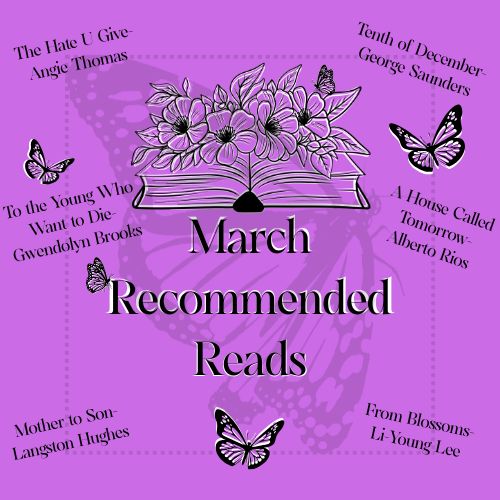

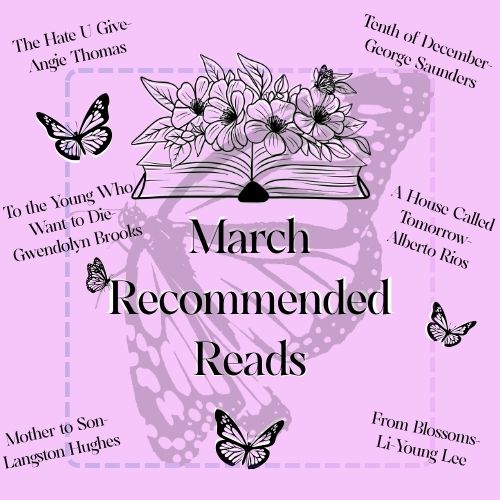
Selections:
- The Hate U Give by Angie Thomas (novel)
- “Mother to Son” by Langston Hughes (poem)
- “To the Young Who Want to Die” by Gwendolyn Brooks (poem)
- “From Blossoms” by Li-Young Lee (poem)
- “A House Called Tomorrow” by Alberto Rios (poem)
- “Tenth of December” by George Saunders (short story)
Thank you for joining me into this recap of the hopeful texts I’ve recommended during midterms. To continue on this journey during these times of uncertainty, I have written the recap not only to give you my interpretations, but also (hopefully) open your eyes to something you might not have seen. For each of these listed selections, I will be revealing things that happened which might spoil the fun of reading the texts. So please, if you want to read them, go ahead and do so before you read this recap! I assure you, they’re all worth reading.
The Hate U Give by Angie Thomas
“I think it’ll change one day. How? I don’t know. When? I definitely don’t know. Why? Because there will always be someone ready to fight. Maybe it’s my turn.
“Others are fighting too, even in the Garden, where sometimes it feels like there’s not a lot worth fighting for. People are realizing and shouting and marching and demanding. They’re not forgetting. I think that’s the most important part.”
Angie Thomas’ The Hate U Give is such an influential story that I believe that people at any age can relate to. It’s a novel that discusses the racial injustices that exist in the world, both the time when it was written and the times that we’re in right now. Starr is such an influential character who clearly undergoes character development, a vital and essential aspect to novels like these.
16-year-old Starr is conflicted with the two different identities she has created of herself: one for the image she presents herself to her friends at school, and the other a more open and colloquial persona to the people in her neighborhood. Although she never knew this existed, you can clearly see this shift into embracing who she is by the end of the novel, understanding that the self-monitoring she has been doing is unnecessary –her friends, family, and boyfriend accept her for who she is. She is willing to cut ties with friends (Hailey) who can’t seem to change for the better and stop making snide and often racist remarks. Not only are social bonds important, but Starr is a fighter for what she believes is good and right.
There is proof in the way she navigates the incident that changes her life. Khalil was a childhood friend of Starr, one who was unjustly fatally shot by a white police officer who believed that Khalil was threatening him with a weapon when, in reality, was just a hairbrush. Reading it, it seems absolutely, completely unjust (and quite frankly, insane) that for holding a hairbrush you risk getting shot to death. What makes matters worse is that it isn’t just because a hairbrush might look like a weapon, but because of what you look like. The injustice that exists in this is simply unfathomable: people don’t ask to be the way that they are sometimes. I can’t even imagine being in Starr’s situation because she had to deal with hiding her identity for her safety, relive what had happened to her with the detectives, and grieve for Khalil.
Starr is a lover for having a tight-knit family, friends, and neighborhood, but she’s also a fighter for wanting to create a catalyst for change. Starr is an inspiration for being a girl willing to speak up about the discrimination and racism that exists in the world. She’s a motivation for the need to believe that a change for the better is possible as long as there are people who are willing to fight for it.
“Mother to Son” by Langston Hughes
“For I’se still goin’, honey,/ I’se still climbin’,/ And life for me ain’t been no crystal stair.”
A 20-line poem published in 1922 in the heat of the Harlem Renaissance by Langston Hughes, an important and famous figure in this time period. The poem is a message from a mother to her son (as the title suggests), asking him to keep moving forward, using her own experience as a foundation for why he should still be moving forward.
“Well son, I’ll tell you:/ Life for me ain’t been no crystal stair.” (l.1) From the very beginning, this support from a mother to her son is so uplifting. Years ago, I presented this poem in front of an entire school for a Black History Program and since then, it has become one of my favorites. The message of this poem helped me gather the courage to confront my anxiety of public speaking to present this beautiful poem.
This free verse poem uses dialect to really portray the voice that the mother has as she tells her son of her experience of climbing up the stairs which haven’t been so easy for her. The powerful transition to speaking directly about her son in line 14 seems to elevate her tone from someone looking back to her past, to someone strong enough to live to tell the tale. You can practically hear the mother’s voice telling her son that she’s still going, still climbing, before repeating the fact that her life wasn’t easy (ll. 18-20). You can feel the hope that seems to be radiating from her voice, not just to the son, but to the audience, to all of you (and me) who seek the determination it seems that everyone but you has, only to reveal that you shouldn’t give in to the obstacles, you shouldn’t give in to your doubts, you shouldn’t give into the rough pavement, because life isn’t always a “crystal stair” (l. 2).
“To the Young Who Want to Die” by Gwendolyn Brooks
“You need not die today./ Stay here–through pout or pain or peskyness./ Stay here.”
A sixteen-line free verse poem that, as the name suggests, is directed to young people who have suicidal ideations. It carefully informs the audience that people don’t have to die today, or tomorrow, or anytime soon by their own hands. The final two stanzas convince the intended audience to remain alive, despite the pain, for tomorrow might be better.
This is the type of poem that seemed best for us to read and relish, leave it as is. But I want to say a few words about it: the poem gives readers hope. It offers hope not just to the intended audience, but to people undergoing something tragic or something as small as a hassle. Everything can wait. The gun, the lake, the vial (ll. 2-3), everything. The poem proceeds to explain repeatedly that people do not have to die today. While the poem touches on a sensitive topic, it addresses it in a calming way, like slowly taking the shaking hands of those who really need to hear that they don’t have to die. Brooks brings hope into her poem that tomorrow can bring the news of the day that’s worthwhile (l. 14) Nothing has to be done now. While other works might encourage audiences to do, feel, or be something, this poem encourages people not to do something. It brings hope to people. Enjoy the little things in life because at the end of the day, we’re green. We are spring (l. 16). We rejuvenate after every hardship, after every winter, just like the spring season does. The speaker is right: nobody with suicidal thoughts needs to die, especially not soon. Not you, nor me, nor anybody else in this world.
“From Blossoms” by Li-Young Lee
“O, to take what we love inside,/ not only the sugar, but the days, to hold/ the fruit in our hands, adore it, then bite into/ the round jubilance of peach.”
Speaking of enjoying the little things in life: eat peaches. Enjoy it. Taste it and really savor each bite. The peach is your little bits of happiness in your life: from the sugar to the days and the shade (ll. 12). So many of us have felt at one point or another “as if death were nowhere/in the background” (ll. 18-19) and it’s these small moments like eating a peach that can grant us this time.
In this poem, the speaker literally talks about eating a peach, but underneath the peach-eating business, there’s an underlying theme of enjoying the small things and cherishing it within ourselves throughout life. We live through many things, but there’s the hope, once again, that there are joys in life to adore and keep close to revisit in the future. It’s like carrying an orchard of peaches of things, particularly moments, we adore within ourselves (ll. 11-12). There’s hope in this poem, though it is subtle, you can see the hints of belief that we oftentimes live as if we never had an end especially in moments like these where we’re just eating a peach.
“A House Called Tomorrow” by Alberto Rios
“Look back only for as long as you must,/ Then go forward into the history you will make./ Be good, then better. Write books. Cure disease./ Make us proud. Make yourself proud.”
This poem, to me, does exactly that. When the world seems to be falling around us, we recall those who were before us, our parents, grandparents, and our grandparents’ parents, and so on. We see the hundreds that were before us (l. 5) and see that we’re made from the good (l. 15), no matter if one member was disagreeable and bad (l. 9-10). And with that, we walk along our lives and do every single thing we put our minds to.
Whether we want to accept it or not, this poem calls to us to look into our pasts and recall that matters could be worse, people before us could have been worse than we think we are. We can move on in our lives knowing that we carry the hundreds of family members before us, and that we carry on their knowledge to use as we wish during our future. Thus, we are able to bring ourselves into every single day that we pass, create ourselves and do everything we can while we’re alive. This poem is also about hope: the promise of tomorrow and what it may bring, a home where we can live in and stay in, looking back only when necessary and for as long as we need to (l. 33). Ourselves. Ourselves. Ourselves: the people we have created, the people we have been shaped into through our hardships and happiness, through our environment and loved ones –that’s all we ever need to carry on to the next day. Even if we aren’t feeling so good, we carry on towards the day that follows, towards “A House Called Tomorrow”.
“Tenth of December” by George Saunders
“ He’d been afraid (..) and yet, at the same time, now saw that there could still be many—many drops of goodness, is how it came to him—many drops of happy—of good fellowship—ahead, and those drops of fellowship were not—had never been—his to withheld.
“Withhold.”
The bullied boy, Robin, who gave into his imagination, had fictional conversations, and pretended to rescue a 53-year-old cancer patient, Don Eber, from freezing to death. The little boy who, because of his attempts to save, ended up changing Don Eber’s mindset and, indirectly, save him from himself.
The beautifully written short story seems to be a silly tale, wholesome and a “happily ever after” type of story. But in reality, readers discover that this story delves into deeper subjects such as suicide, bullying, and the existence of “drops of goodness” in life. We see this primarily through Don Eber. He was trying to commit suicide, trying to end it all so that he doesn’t become “THAT” as Allan had. But he didn’t. He didn’t end up ending it all because he found something good, little, but existing. So many people who commit suicide think that ending their life would remove the pain.
Don Eber shows the reality of surviving.
Things don’t get immediately better. There’s no overused ending where everything is resolved: Don Eber still has cancer, Robin and his mother will still likely be made fun of, and Molly, Don Eber’s wife, isn’t just happy that he’s still alive –she’s angry and embarrassed. But what’s revolutionary here is the hope that exists in between the goodness: “those drops of fellowship were not –had never been– his to withheld. Withhold”. Eber knew, he knew that those little times of happiness exist in the future, covered by some of the bad moments, but there, existing. Don Eber literally decided not to go through with the suicide by the end of the short story because of those little moments of goodness. It’s a message, a lesson you might say, that goodness exists in the world. It might be hidden, and nearly invisible at the moment, but it’s there, it exists, it survives.
Thank you for taking the time to read over this recap and I hope you have found these reads to be as helpful as I have. For tomorrow there will be news, as Gwendolyn Brooks imagines, and we don’t need to leave today even if we’re alone. When you go through the seasons and you find a storm, “When you hear thunder,/Hear it as applause,” as Alberto Rios interprets, for despite life not being a “crystal stair” like the speaker in Langston Hughes’ poem puts it, we might not be good, but we’re getting better. Quitting may be easy, but it’s never just about the events in our life, sometimes it’s about the fate of many others, as Starr would remark. There is so much hope in this world, so much to look forward to, little drops of goodness here and there as George Saunders sees. We just need to grasp it, relish it, and, like Li-Young Lee, enjoy it like we would a bite of a peach.
I hope you heard the things you needed to hear, when you needed to hear them most. And I thank your time and effort, for my time writing this recap has been amazing. Look out for the April recommended reading list.